

“Garbage in, profit out…or not?”
In modern agriculture, data is everywhere. Every feed delivery, treatment, weight, litre of diesel, rainfall record, fuel usage, seed per hectare, hour of labour and number of progenies contributes to a growing pool of information on the farm. The assumption is often that more data leads to better decisions. But that assumption is flawed. The real problem is not a lack of data. It is a lack of accurate, consistent, and biologically meaningful data.
The Illusion of “Having Data”
Most farms already record a wide range of information: birth data and litter performance, feed deliveries and usage, treatments and health events, weights at different stages, and slaughter data. On paper, this looks like a well-managed, data-driven system. Many of these datasets are compromised by inconsistent recording between people or batches, human error during capturing, delayed entries based on memory, and guesswork when numbers are missing.
The result is a dangerous situation: false confidence in incorrect numbers. A farm may believe it is making data-driven decisions, while in reality it is reacting to noise.
Why Accuracy Matters Biologically
In animal production, small errors do not stay small. They compound. Consider average daily gain (ADG). A miscalculation of just 50 g/day may seem insignificant, but over a grower-finisher period this can translate into a difference of 5 – 7kg at slaughter. That affects feed efficiency, days to market, and ultimately profitability.
The same applies to mortality classification. If deaths are incorrectly recorded as crushing instead of starvation, the response will focus on infrastructure or sow behaviour rather than nutrition or piglet management. The wrong diagnosis leads to the wrong solution.
For sheep farmers, reproductive data illustrates the same principle. If lambing percentages are overstated due to inaccurate records, flock fertility may appear adequate when it’s not. Issues such as poor conception rates, ewe condition, or lamb survival remain hidden. The result is fewer lambs weaned per ewe than expected, reducing output and profitability.
For crop farmers, planting data is equally critical. If seeding rates or planting dates are incorrectly recorded, yield outcomes cannot be accurately interpreted. Poor yields may be attributed to weather or soil, when the real cause is suboptimal plant population or timing. Decisions on inputs and management are then based on false assumptions, limiting improvement in yield and efficiency.
From a biological perspective, this is critical. Every decision we make on farm, whether related to nutrition, health, or management, is based on an interpretation of data. If that interpretation is built on inaccurate inputs, it distorts the entire system.
Sources of Inaccuracy
It is easy to blame systems or technology for poor data, but most inaccuracies originate elsewhere.
1. Human behaviour
Most data errors are behavioural, not technical, such as delayed capturing after long days, filling in gaps from memory, and recording what “should have happened” rather than what did. People naturally optimise for speed and simplicity, not precision. Without structure, accuracy will always suffer.
2.System limitations
Even with good intent, systems can fail – scales that are not calibrated, feed usage estimated instead of measured, multiple recording points creating conflicting data or even simple typo’s from redundant recording on multiple places.
3.Biological variation hidden by averages
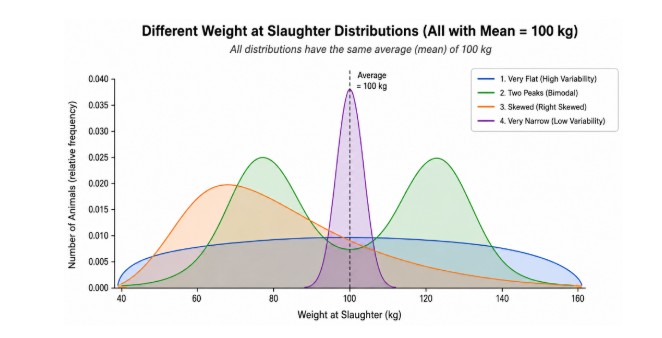
Averages can be misleading. A herd may report an ADG of 800 g/day, but this could hide a large group of animals growing below 700 g/day and a smaller group growing above 900 g/day. This is not one uniform population. It is a system with variability that needs to be understood and managed. Ignoring variation leads to incorrect conclusions about performance and limits the ability to improve.
What Should Actually Be Measured?
The solution is not to collect more data, but to collect insightful data accurately. The focus should be on collecting high-impact variables such as total born, weights at key stages, feed delivered and mortalities that serve as indicators for many other factors.
For livestock, body condition scoring is a high-impact measure that is often overlooked or recorded inconsistently. Tracking condition at key stages (e.g. pre-breeding, late gestation, weaning) provides early warning of nutritional imbalances or diseases. Looking beyond the average score to the distribution within the herd reveals how many animals are under- or over-conditioned, allowing for more precise feeding and management.
For crop farming, plant population is a critical variable. Measuring actual plants established per hectare, rather than relying on intended seeding rate, gives a true picture of stand performance. Examining variability across fields or zones highlights areas of poor establishment, enabling targeted corrections in planting practices, input use, or soil management.
In addition, do not only look at averages. Understand the spread of data for example how many animals fall below target and how many exceed expectations? This is where real insight begins.
Practical Rules for Improving Accuracy
Improving data accuracy does not require expensive technology. It requires discipline.
- Standardise definitions – Ensure everyone records data the same way, especially for key areas like mortality.
- Reduce complexity – Limit options and simplify recording systems. Complexity increases errors.
- Assign responsibility – One person accountable for each dataset reduces duplication and gaps.
- Train staff on the “why”– People record better data when they understand how it affects performance and profitability.
- Validate regularly – Review data weekly. Look for inconsistencies, missing values, or unrealistic trends.
- Focus on repeatability – Data must be consistent over time to be useful. A perfect number once is less valuable than a consistent trend.
The Cost of Getting It Wrong
Inaccurate data does not just create confusion. It costs money. Incorrect feed data leads to poor formulation decisions. Misinterpreted growth rates delay market timing. Wrong mortality causes, lead to wasted interventions. Every decision built on weak data compounds the error further down the production chain.
Final Thought
There is a common belief that better technology will solve data problems. In reality, technology often amplifies them if the underlying discipline is not in place. The most successful farms are not those collecting the most data. They are the ones collecting fewer, high-impact data points accurately and consistently, and using them to guide decisions.
Accurate data is not a technical problem. It is a management discipline.