
Livestock farming has always relied on skill and stockmanship. Today, however, commercial success increasingly depends on the ability to measure, analyse and interpret data in real time. As Lord Kelvin famously noted, when you can measure what you are speaking about and express it in numbers, you move from guesswork to knowledge. This principle now underpins modern, data driven livestock production.
Data Collection: The Starting Point for Better Decisions
Every farm generates continuous streams of information. Birth weights, litter sizes, mortality, water intake, feed deliveries, temperatures, treatments and slaughter outcomes all reflect biological and financial performance. Historically, much of this was captured irregularly or left forgotten in a file. Today, accurate, consistent data collection allows farmers to detect problems early, evaluate improvements and understand long term trends.
Scientific literature confirms the rapid rise of analytics and machine learning in pig production since 2018, particularly for health monitoring, feeding decisions and genetic evaluation. Yet most research still uses small experimental groups rather than commercial scale herds, highlighting the need for farms to collect their own robust, real world data.
Without structured data, key questions remain speculation. Why did fertility decline. Why did FCR increase. Which gilts will become the most productive sows. With continuous data, these become answerable. Early life traits become predictors of lifetime productivity, longevity and value. Correlations reveal optimal breeding points. Producers can also evaluate whether long standing herd guidelines still match current genetics rather than those of twenty years ago.
A Holistic View of an Interconnected System
Livestock systems are dynamic and interconnected. Small changes in one phase can influence results months later. Heat stress may reduce farrowing rate. Poor colostrum intake may depress growth long after weaning. Minor variations in feed quality may only appear at slaughter through fat scores or dressing percentage.
Because of these interactions, a holistic and long term perspective is essential. Internal benchmarking reveals whether interventions truly worked or simply coincided with seasonal patterns. External benchmarking places a farm’s results in context, preventing normal variation from being mistaken for crisis and highlighting both strengths and areas needing improvement.
A systems perspective also illustrates how nutrition interacts with health, how genetics interacts with environment and how staff behaviours shape outcomes as much as diets
or facilities. Better decisions emerge when producers see the farm as a connected ecosystem rather than isolated numbers.
Real Time Data: Moving From Reactive to Proactive Farming
Modern farms can now capture information continuously. When temperatures rise in a farrowing room, when water intake drops in a single pen or when growth deviates from the predicted curve, digital systems detect these signals immediately. Real time data allows early intervention rather than waiting for visible symptoms or performance losses.
Timely action protects productivity. Ventilation can be corrected before heat stress reduces litter size. A faulty nipple can be repaired before pigs fall behind. Sow feeding issues can be addressed before farrowing outcomes suffer. In modern farming, the speed of insight directly affects biological success.
Real Time Data Grows Stronger When Combined With Big Data
Real time information becomes far more powerful when interpreted alongside large scientific and industry datasets. Herd management and benchmarking systems containing millions of animal records define what normal looks like across seasons, genetics and production systems.
Comparing live data with these pooled datasets improves interpretation. A spike in preweaning mortality may be normal for the season. An FCR deviation may indicate a meaningful issue once compared with similar farms. Slower gilt growth becomes actionable when clearly below peer curve expectations. Big data provides context, real time data provides immediacy and together they create the strongest decision support system agriculture has ever had.
Integrating Data Across the Value Chain
Integrating production, health, feed and carcass data is one of the most powerful opportunities in livestock farming. Whole chain datasets remain rare, yet they provide the deepest insights. Linking abattoir metrics such as fat depth, fat quality, ulcer scores, condemnations and dressing percentage to on farm data reveals which diets deliver the best carcass margin, which management systems contribute to preventable lesions and which sows produce the most carcass meat at the lowest cost.
This shifts thinking from managing for production alone to managing for final value.
Visualisation Makes Information Useful
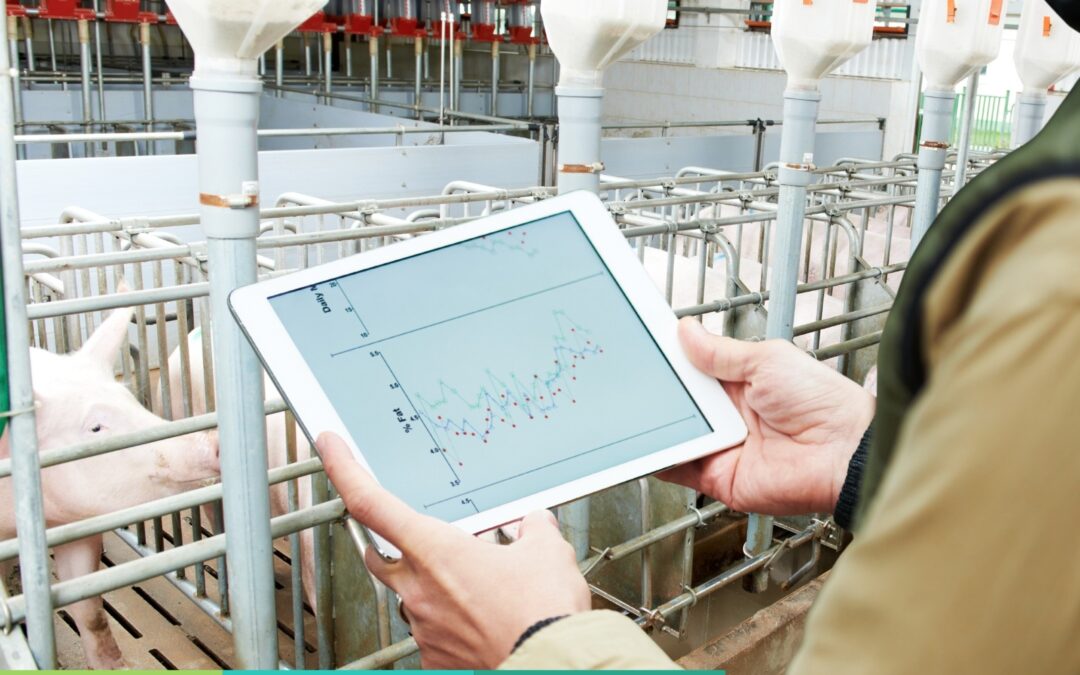
Data only drives decisions when people can understand it. Clear, intuitive visualisation helps staff and managers recognise trends quickly. Research shows that dashboards accelerate adoption of technology and improve decision making. A simple graph
comparing pigs weaned per sow per year to regional averages communicates far better than spreadsheets.
The Economic Advantage of Faster, Informed Responses
Real time, data supported decision making delivers measurable financial benefits. Feed efficiency improves when deviations are corrected immediately. Early disease detection reduces mortality and medication costs. Continuous monitoring stabilises reproductive performance. Carcass value increases when growth and fat deposition are managed proactively. Labour becomes more efficient when actions are driven by alerts rather than routine searches.
Top performing farms do not necessarily work harder; they respond faster, with better information.
Blending Stockmanship With Science
You do not need running shoes to finish a marathon, but they certainly help. Data will never replace stockmanship, but it strengthens it. Most farms already collect the necessary information. The next step is to add value by analysing, visualising and interpreting it to support real time, on farm decisions.
By viewing production holistically, collecting continuous data, benchmarking against large datasets and integrating information across the value chain, farms can move from reacting to problems toward predicting and preventing them. In a sector defined by tight margins and biological variability, this shift is transformative.
Hi, this is a comment.
To get started with moderating, editing, and deleting comments, please visit the Comments screen in the dashboard.
Commenter avatars come from Gravatar.